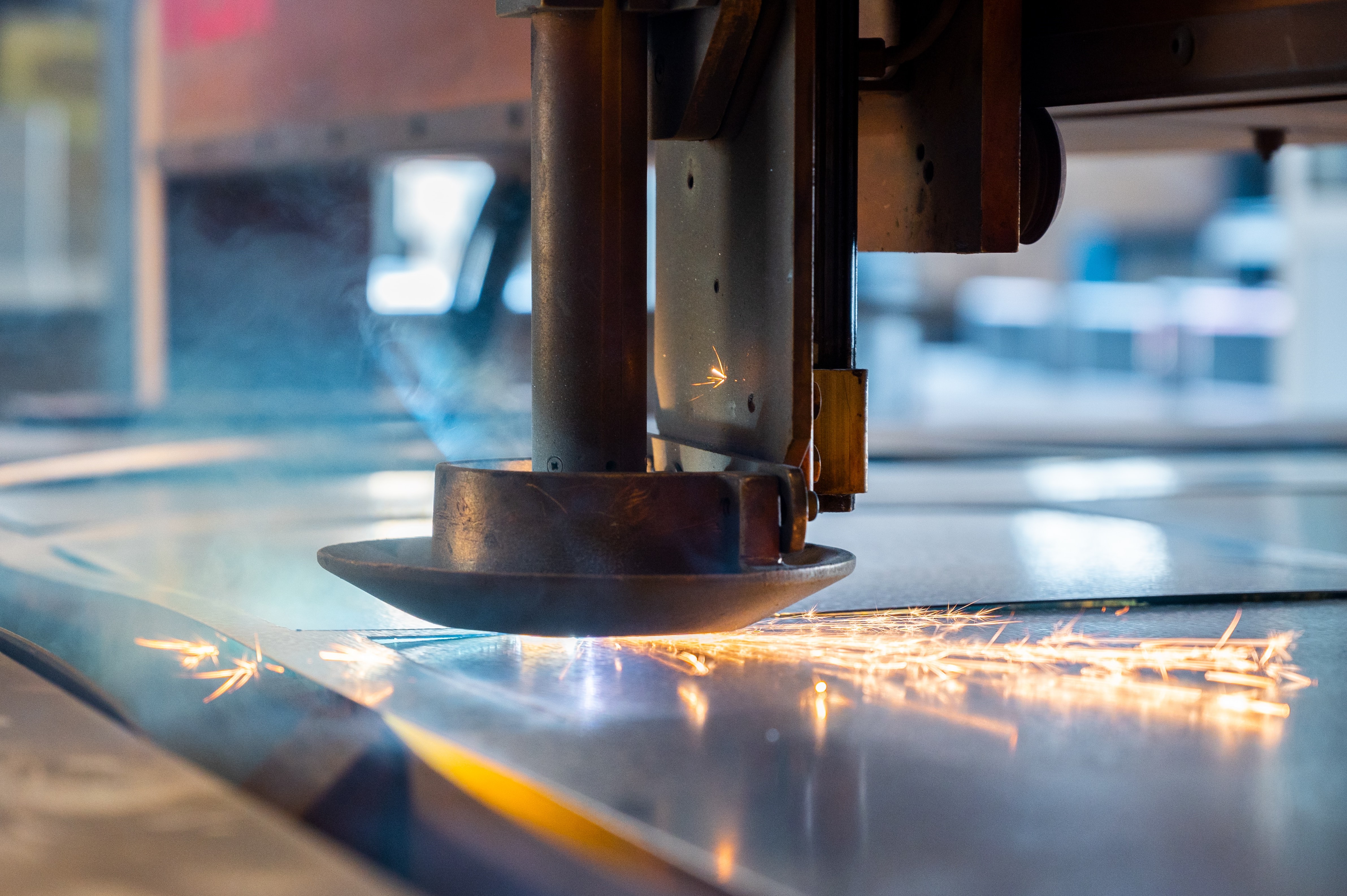
Print and Apply Applicator Types: Tamp, Tamp-Blow, Blow-On, Wipe-On, Corner Wrap and Pallet

Two print and apply systems can use the same printer, the same ribbon and the same label, and still be completely different machines. What separates them is the applicator: the part that takes the printed label off the backing web and puts it on the pack. Tamp, tamp-blow, blow-on, wipe-on, corner wrap and pallet applicators each place a label in a different way, and the right one depends on the surface, the speed and whether the pack can be touched at all.
This guide covers the six applicator formats used on print and apply labelling systems, what each one suits, and how to work out which format your line needs before you ask for a quote.
Why the applicator decides the machine
Every print and apply system does the same three things in sequence. A sensor detects the pack, a thermal transfer print engine prints that pack's label with live data from your line system, and the applicator places it. The print side is largely settled: it is thermal transfer, and the variable is ribbon grade rather than mechanism. The applicator side is where the choices are.
Get the applicator wrong and the symptoms show up straight away. Labels land crooked, skew off the edge, lift at one corner, or the machine cannot keep pace and packs go past unlabelled. None of that is fixed by a better printer. It is fixed by matching the application method to the pack.
Tamp applicator
A tamp applicator holds the printed label on a vacuum pad. A pneumatic cylinder extends the pad to the pack, presses the label on with light contact, releases the vacuum and retracts. Also called a tamp pad, tamp-on or contact applicator.
Tamp gives the most accurate placement of any format because the pad reaches the surface and puts the label exactly where the stroke ends. That makes it the default for recessed panels, ridged or slightly uneven faces, and any application where the label has to sit in the same spot every time.
The trade-off is time. The stroke has to extend and retract between packs, so throughput is limited by pad travel, and the pack normally has to be stationary or moving slowly and predictably as the pad arrives. Contact also rules out packs that deform, so soft bags and lightweight shrink-wrapped packs are usually better on one of the non-contact formats.
Tamp is not limited to cartons. On a long-stroke arm the same format labels pallets, which is why a single-face pallet label is often applied by a tamp rather than by a dedicated pallet system.
Suits: cartons and cases on an indexing conveyor, crates, trays, drums, firm packs, recessed surfaces, single-face pallet labels, high placement accuracy.
Tamp-blow applicator
A tamp-blow applicator works like a tamp for most of the stroke, then stops short of the pack and uses a puff of air to push the label across the last few millimetres. The pad never touches the product. Also called tamp-blow, tamp and blow, or near-contact application.
This is the format for packs that cannot take contact but still need accurate placement. Because the pad travels most of the way, the label is released close to the surface, so it keeps most of the accuracy of a true tamp without pressing on the pack. It also tolerates a surface that sits at a slightly different distance from one pack to the next, which is common with filled bags and soft cases.
Suits: filled bags and pouches, shrink-wrapped packs, soft or crushable cartons, product that must not be pressed, packs where the surface height varies a little.
Blow-on applicator
A blow-on applicator has no stroke at all. The printed label is held by vacuum on a fixed grid pad and fired onto the pack by compressed air as it passes. Also called air-blow, air-jet or non-contact application.
With nothing to extend and retract, a blow-on head cycles faster than a tamp and can label product that keeps moving, which is why it turns up on continuous lines and on delicate items. The limits are worth knowing before you specify it. Accuracy is lower than a tamp because the label crosses an air gap unguided, the gap has to stay consistent, draughts and nearby fans affect placement, and air consumption is higher than the other formats. Large labels are harder to control in flight than small ones.
Suits: continuously moving packs, fragile or lightweight product, applications where a mechanical stroke would be too slow, small to medium labels.
Wipe-on applicator
A wipe-on applicator is the simplest of the group. The label is peeled at the edge of a roller or brush, its leading edge tacks onto the moving pack, and the pack's own motion pulls the rest of the label off the backing web while the roller wipes it down. Also called wipe-on, roll-on or rolling application.
Fewest moving parts, lowest cost, and it keeps up with a fast continuous line without any air at all. It is the right answer when the surface is flat, firm and travelling past at a steady speed, which describes most straightforward top or side carton labelling.
Wipe-on also handles two adjacent sides. Because the pack's own travel drags the label off the web, the label can be wiped around the leading corner onto the second face in the same pass, which is one of the ways a two-side or corner label is applied.
What it will not do is handle a stop-start line, a recessed face or a pack whose position wanders on the conveyor. Wipe-on depends on the pack arriving square, at speed, every time, so container control and guide rails matter more here than on any other format.
Suits: flat-sided cartons and cases at steady line speed, top and side labelling, two adjacent sides in one pass, high volume, budget-sensitive lines.
Corner wrap applicator
A corner wrap applicator puts one label across two adjacent faces, so the label bends around the vertical or leading corner of the pack and reads from either side. Also called corner wrap, corner-wrap labelling or two-panel application.
Most corner wrap heads apply the first panel with a tamp or a tamp-blow, then the second panel is wiped around the corner as the pack moves on. Getting the fold to land exactly on the corner is the whole job, so the pack has to be guided tightly and the label length has to match the two panel widths.
Two reasons lines specify it. The first is scanning: a case that might be stacked or palletised either way still presents a readable barcode, so the depot scanner finds it without the pallet being turned. The second is tamper evidence, where a single label bridging the flap and the side of a carton shows if the box has been opened.
Suits: cases that must scan from two sides, produce and meat cartons, tamper-evident sealing, square tubs and boxes stacked in mixed orientation.
Pallet applicator
A pallet applicator is what you specify when two or three sides of every pallet have to be labelled. That is the line between the formats above and a dedicated pallet system: a single label on one face can be applied by a long-stroke tamp, but once the same pallet needs a label on two or three faces, the job belongs to a pallet applicator built for it.
The machine is built on a mast or tower rather than a conveyor frame. The head travels vertically to the correct label height and applies a large dispatch label to the pallet face, usually with a long tamp stroke because pallets are stationary or conveyed slowly at that point. Two or three faces are labelled without the pallet being turned, so the pallet scans from either aisle in the warehouse. A single label can also be corner-wrapped across two faces instead of applying two separate labels.
Pallet labelling is always print and apply, because every pallet carries a unique serial shipping container code. There is no pre-printed roll that can do it.
Position in the line matters too. A pallet labeller normally sits between the palletiser and the stretch wrapper, so labelling before wrapping puts the label under the film where it cannot be knocked off, and labelling after wrapping keeps it replaceable. Where cases are stacked by a cobot palletiser, the pallet labeller goes in after the palletiser hands the pallet off.
Suits: finished pallets that need two or three faces labelled, serial shipping container code labels, warehouse and third-party logistics despatch.
Which applicator for which job
| Applicator | Contact | Placement accuracy | Pack must be | Typical use |
|---|---|---|---|---|
| Tamp | Yes | Highest | Stationary or slow | Cartons, crates, drums, recessed faces, single-face pallet labels |
| Tamp-blow | No | High | Stationary or slow | Bags, pouches, soft or fragile packs |
| Blow-on | No | Moderate | Moving, consistent gap | Fast lines, delicate product |
| Wipe-on | Yes | Moderate | Moving at steady speed | Flat cartons and cases, two adjacent sides in one pass, high volume |
| Corner wrap | Yes | High | Guided tightly | Two-sided scanning, tamper evidence |
| Pallet | Yes | High | Stationary or slow | Pallets needing two or three faces labelled |
Contact or non-contact
The first question to settle is whether the pack can be touched. If pressing on the surface would dent, crush or mark the product, the choice narrows to tamp-blow or blow-on straight away, and everything else follows from there.
If contact is fine, the next question is whether the pack stops. A pack that indexes and pauses suits a tamp. A pack that never stops suits a wipe-on if the face is flat and a blow-on if it is not, or if the product is too delicate to wipe. Lines that run mixed pack types often end up with a tamp-blow, because it copes with the widest range at the cost of some cycle time.
What decides the applicator on your line
- Surface. Flat and firm, recessed, ridged, curved or soft. Recessed and uneven faces need a stroke that reaches in.
- Does the pack stop. Indexing conveyors allow tamp formats. Continuous motion pushes you to wipe-on or blow-on.
- Label position. Top, side, front, two faces, or a specific panel that must be hit within a few millimetres.
- Packs per minute at the labeller. Count at the labelling point, not at the filler. Tamp stroke time is the usual ceiling.
- Label size. Large dispatch labels are harder to blow accurately and need a bigger pad and a wider web path.
- Pack consistency. If the surface distance or the pack position varies from unit to unit, allow for it in the format rather than hoping guide rails fix it.
- Environment. Chilled, damp, dusty or draughty areas affect both adhesive choice and the practicality of a blow-on head.
The applicator is only half the specification
Choosing the format settles how the label gets onto the pack. Two other decisions sit alongside it. The first is whether you need print and apply at all: if every label in the run is identical, a standard applicator dispensing pre-printed labels is cheaper and simpler, and our guide to print and apply labelling covers where the line falls. For labelling configurations on retail containers rather than cases, see label applicator types.
The second is the consumable. Print and apply systems run a thermal transfer print engine, and ribbon grade decides whether the print survives the trip. Wax suits paper labels in dry storage, wax-resin handles the coated papers and light synthetics most cartons use, and full resin is for synthetic labels facing moisture, abrasion, freezing or chemical contact. A label that scans on the line and fails at the depot is almost always a ribbon problem rather than an applicator problem.
Print and apply systems supplied Australia-wide
Nexus Australia supplies, installs and commissions print and apply labelling systems in every Australian state and territory, with installations over the last three years in Perth, Melbourne, Shepparton, Sydney, Brisbane and Adelaide, and shipments to New Zealand. Each system is configured to the pack, the label and the line speed rather than sold off the shelf, so the applicator format is chosen against your actual cartons or pallets.
Every machine is supported after handover with operator training, preventive maintenance, spare parts and technical help. Phone and video-call troubleshooting is free, and where a fault needs hands on it a Nexus technician or an approved contractor in your state attends. Common spare parts are held in Australia. Warranty is 12 months return-to-base with wear parts excluded. Lead time to shipment is about 75 days for a standard machine and 90 to 120 days for a complex one, then freight and installation. All pricing is by quotation. Nexus Australia is a member of APPMA, the Australian Packaging and Processing Machinery Association.
Frequently asked questions
What is a tamp applicator on a print and apply machine?
A tamp applicator holds the printed label on a vacuum pad and extends that pad on a pneumatic cylinder to press the label onto the pack. It gives the most accurate placement of any format and handles recessed or uneven surfaces, but the pack normally has to be stationary or moving slowly while the pad arrives.
What is the difference between tamp-blow and blow-on?
Both apply the label without touching the pack. A tamp-blow pad travels most of the way to the surface and then releases the label with a puff of air over the last few millimetres, so accuracy stays high. A blow-on head does not move at all and fires the label across a larger air gap, which is faster but less precise.
Which applicator is best for cartons and cases?
Flat, firm cases running at a steady speed are usually labelled wipe-on or tamp. Soft or shrink-wrapped cases go to tamp-blow. If the case has to scan from two sides, corner wrap applies one label across both faces. Our box and carton labelling guide covers the case-labelling decision in full.
Do I need a corner wrap applicator?
Only if a single face is not enough. The two reasons to specify it are barcodes that must read regardless of how the case is stacked, and tamper-evident labels that bridge a carton flap and the side wall. Otherwise a single-panel applicator is simpler and cheaper.
When do I need a pallet applicator rather than a tamp?
When two or three sides of the pallet have to be labelled. A single label on one face can be applied by a long-stroke tamp arm. A pallet applicator is the machine built for labelling two or three faces of the same pallet without turning it, so it scans from either aisle.
How does a pallet label applicator work?
The head is mounted on a mast, travels to the right height and applies a large dispatch label to the pallet face, normally with a long tamp stroke because the pallet is stationary or moving slowly. Because every pallet has a unique serial shipping container code, pallet labelling is always print and apply.
Can one print and apply machine change applicator type later?
The print engine and controller are common across formats, and applicator heads are a configured option rather than a fixed part of the machine, so a change is possible on many systems. It is not a five minute job and it depends on the specific system, so tell us the full range of packs you expect to run and the format is chosen with that in mind from the start.
Related machines and guides
- Print and apply labelling systems
- Labelling machines
- Thermal transfer printers
- What is print and apply labelling
- Box and carton labelling machines
- Label applicator types
- Label applicator vs labelling machine
Tell us your pack format, label size, line speed and whether the pack can be touched, and we will specify the applicator. Contact Nexus Australia for a quote on a print and apply labelling system.
Ready to Automate Your Production Line?
Talk to our packaging machinery experts today. Whether you need a standalone filling machine or a complete turnkey robotic system, we have the engineering expertise to scale your operations.